Unlock Value: Buy Prebuilt Gaming PC Under $1000
buy prebuilt gaming pc under 1000

Unlock Value: Buy Prebuilt Gaming PC Under $1000

Achieve an immersive gaming experience without breaking the bank with our expert guide to affordable prebuilt PCs.

Find Your Dream PC

Key Takeaways

  • ✓ It is entirely possible to find a capable prebuilt gaming PC under $1000 that runs modern titles.
  • ✓ Focus on CPU/GPU balance, RAM, and SSD storage for the best performance in this price range.
  • ✓ Major retailers and specialized builders offer competitive options for budget-conscious gamers.
  • ✓ Compromises are inevitable, but smart choices can minimize their impact on your gaming experience.

How It Works

1
Define Your Gaming Needs

Determine which games you primarily want to play and their recommended system requirements. This helps prioritize components and avoid overspending on unnecessary power.

2
Research Key Components

Understand the basics of CPUs (Intel i5/Ryzen 5), GPUs (NVIDIA GTX/RTX, AMD RX), RAM (16GB recommended), and SSDs. This knowledge empowers you to evaluate prebuilt specifications effectively.

3
Compare Prebuilt Systems

Scour reputable retailers and PC builders, comparing specifications, prices, and user reviews. Look for sales and bundled deals that offer extra value within your budget.

4
Check for Expandability & Support

Ensure the chosen system allows for future upgrades (e.g., adding more RAM, storage) and comes with a reliable warranty and customer support. This protects your investment long-term.

Navigating the Market: How to Find a Budget Gaming PC Under $1000
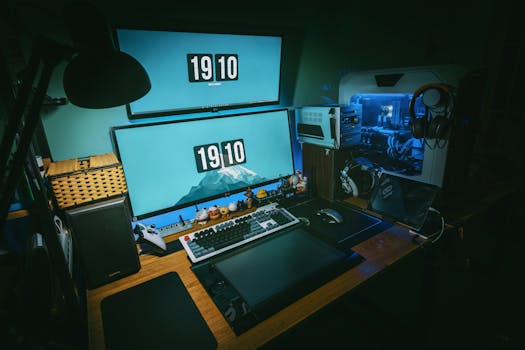
A sleek gaming desk setup featuring dual monitors, keyboard, and gaming PC in a dimly lit home office. Photo: FOX ^.ᆽ.^= ∫ / Pexels
The quest to buy a prebuilt gaming PC under $1000 can feel like a daunting challenge, especially with the ever-evolving landscape of hardware and game requirements. However, it's a completely achievable goal, provided you approach it with a strategic mindset and a clear understanding of what to prioritize. Many aspiring gamers and even experienced enthusiasts are often surprised by the sheer capability of systems available in this budget bracket. The key is to manage expectations and make informed decisions about where to allocate your precious dollars. You won't be building a top-tier, ultra-settings, 4K ray-tracing monster, but you can absolutely secure a machine that delivers a smooth, enjoyable 1080p gaming experience on most modern titles, often at high settings. The market for prebuilt systems has become incredibly competitive, with manufacturers like CyberPowerPC, iBUYPOWER, Skytech Gaming, and even larger brands like HP and Dell (with their Omen and Alienware Aurora lines, respectively, though Alienware often pushes past this budget) vying for your attention. This competition is a huge advantage for the budget-conscious buyer, leading to better component choices and more aggressive pricing. When you set out to buy a prebuilt gaming PC under $1000, your primary focus should be on the core components that directly impact gaming performance: the Central Processing Unit (CPU) and the Graphics Processing Unit (GPU). These two pieces of hardware will dictate the frame rates you achieve and the graphical fidelity you can enjoy. Alongside these, sufficient RAM and fast storage are crucial for overall system responsiveness and game loading times. Don't fall into the trap of being swayed by flashy RGB lighting or an oversized case if it means compromising on the internal specifications. While aesthetics are nice, performance is paramount for gaming. Furthermore, it's essential to understand that 'under $1000' means different things at different times of the year. Black Friday, Cyber Monday, Amazon Prime Day, and other major sales events are prime opportunities to snag a significantly better deal than you might find during regular periods. Keeping an eye on tech news sites and deal aggregators can give you a significant edge in finding these elusive bargains. Always check the full specifications list, not just the highlights, as sometimes crucial details (like single-channel vs. dual-channel RAM, or the actual wattage of the power supply) can be overlooked. Remember, the goal isn't just to get *any* PC, but to get the *best possible* gaming PC within your $1000 budget, ensuring it provides a solid foundation for your gaming adventures. For more insights on general gaming PC considerations, check out our guide on building a gaming PC.

Crucial Components: What to Prioritize for Performance and Value
Close-up of a colorful RGB cooling fan in a gaming PC setup. Photo: Official Glacier / Pexels
When your budget is capped at $1000, every dollar counts, and making smart choices about component prioritization is key to maximizing your gaming experience. The single most important component in a gaming PC is arguably the Graphics Processing Unit (GPU). This is where the heavy lifting of rendering game visuals takes place. For a prebuilt system under $1000, you'll typically be looking at GPUs such as the NVIDIA GeForce GTX 1660 Super, RTX 3050, or AMD Radeon RX 6600. The RX 6600 often provides excellent value, sometimes outperforming the GTX 1660 Super and even rivaling the RTX 3050 in raw rasterization performance, making it a strong contender for budget builds. The RTX 3050 offers the advantage of DLSS technology, which can significantly boost frame rates in supported games, and basic ray tracing capabilities, though ray tracing at this price point is often a compromise. Aim for at least 6GB of VRAM, with 8GB being ideal for future-proofing and handling higher texture settings in modern games. Next in line is the Central Processing Unit (CPU). While the GPU handles graphics, the CPU is responsible for game logic, AI, physics, and feeding instructions to the GPU. A well-balanced system requires a capable CPU that won't bottleneck your chosen GPU. In the sub-$1000 range, you'll commonly find Intel Core i5 (10th, 11th, or 12th generation) or AMD Ryzen 5 (3000, 5000, or even 7000 series, though the latter is less common) processors. An Intel i5-10400F, i5-11400F, or i5-12400F, or an AMD Ryzen 5 3600, Ryzen 5 5500, or Ryzen 5 5600 are excellent choices. These CPUs offer sufficient core counts and clock speeds to handle current games and general multitasking without holding back a mid-range GPU. Avoid older generations if possible, as the performance gains in newer iterations are substantial. RAM (Random Access Memory) is another critical factor. While 8GB of RAM might get you by in some games, 16GB is the sweet spot for modern gaming, allowing you to run games smoothly while also having background applications open. Look for systems with 16GB DDR4 RAM, preferably running at speeds of 3200MHz or higher. Crucially, ensure the RAM is configured in dual-channel mode (e.g., two 8GB sticks) rather than single-channel (one 16GB stick), as dual-channel significantly improves performance, especially for Ryzen CPUs. Finally, storage: an NVMe SSD (Solid State Drive) is non-negotiable. It provides dramatically faster game loading times, boot times, and overall system responsiveness compared to traditional HDDs. Aim for at least a 500GB NVMe SSD, with a 1TB drive being ideal. Some systems might offer a smaller SSD paired with a larger HDD for bulk storage; this can be a viable compromise if the SSD is large enough for your primary games. Don't overlook the power supply unit (PSU) either; a reputable brand and sufficient wattage (typically 500W-650W for these configurations) are important for stability and future upgrades. A generic, unbranded PSU can be a red flag.

Where to Buy & What to Expect: Retailers and Performance Benchmarks

An immersive gaming room with neon lights, computers, and gaming chairs ready for a tournament. Photo: Yan Krukau / Pexels
When you're ready to buy a prebuilt gaming PC under $1000, knowing where to look is half the battle. Several retailers and specialized PC builders consistently offer compelling options in this price bracket. Major online retailers like Amazon, Best Buy, and Newegg often have sales on prebuilt systems from brands like CyberPowerPC, iBUYPOWER, Skytech Gaming, and MSI. These platforms are excellent for price comparisons and reading user reviews, which can provide valuable insights into real-world performance and customer service experiences. Dedicated PC builders like those mentioned above also sell directly from their websites, sometimes offering more customization options or exclusive deals. It's always worth checking their official sites in addition to the major retailers. Micro Center, if you have one nearby, can be a fantastic resource, often having competitive prices and knowledgeable staff, plus the convenience of in-store pickup. What kind of performance can you realistically expect from a prebuilt gaming PC under $1000? With a system featuring an AMD Ryzen 5 5600 or Intel Core i5-12400F paired with an AMD Radeon RX 6600 or NVIDIA GeForce RTX 3050, 16GB of 3200MHz DDR4 RAM, and a 500GB NVMe SSD, you can expect solid 1080p gaming performance. For popular esports titles like Valorant, CS:GO, League of Legends, and Overwatch 2, you'll easily achieve well over 100-144+ FPS on high settings, making them ideal for high refresh rate monitors. More demanding AAA titles like Cyberpunk 2077, Assassin's Creed Valhalla, or Red Dead Redemption 2 will typically run at 1080p with a mix of medium to high settings, yielding comfortable frame rates of 45-70+ FPS, providing a very playable and enjoyable experience. Games optimized with FSR (AMD FidelityFX Super Resolution) or DLSS (NVIDIA Deep Learning Super Sampling) will see even better performance, often pushing frame rates higher on medium-to-high settings. While 1440p gaming is generally out of reach for consistent high frame rates at this budget, some less demanding titles or older games might be playable at 1440p with lower settings. Always look for benchmark videos on YouTube for specific games and component combinations to get a clear picture of expected performance. Remember that monitor choice also plays a significant role; investing in a good 1080p 144Hz monitor will greatly enhance your gaming experience even with a budget PC. For more details on optimizing your gaming setup, consider reading about essential gaming peripherals.

Avoiding Pitfalls: Common Mistakes and Upgrade Paths

When you buy a prebuilt gaming PC under $1000, it's easy to fall into common traps that can diminish your overall satisfaction. One of the biggest mistakes is focusing solely on the CPU or GPU without considering the balance between them. A top-tier GPU paired with an ancient CPU, or vice-versa, will lead to a significant bottleneck, meaning one component is waiting on the other, wasting potential performance. Always aim for a balanced system where the CPU and GPU are roughly proportional in power. Another common pitfall is neglecting the power supply unit (PSU). While less glamorous, a cheap, unbranded, or insufficient PSU can lead to system instability, crashes, and even damage to components. Ensure the prebuilt system includes a PSU from a reputable brand (e.g., Corsair, EVGA, Seasonic, Cooler Master) with adequate wattage for the components and a little headroom for future upgrades. Don't forget to check the warranty and return policy; sometimes, a slightly higher price from a reputable builder comes with better support, which can be invaluable. Looking ahead, even a budget prebuilt PC should offer some upgrade potential. The most common and impactful upgrades you might consider in the future include: * **More RAM:** If your system came with 8GB, upgrading to 16GB is often the first and most cost-effective performance boost. * **Additional Storage:** A larger SSD or a secondary HDD for game libraries will quickly become necessary as game sizes grow. * **GPU Upgrade:** This will be the most significant performance leap. Ensure your PSU has enough wattage and appropriate connectors for a more powerful card. * **CPU Upgrade:** This is often more complex as it might require a new motherboard if you jump generations (e.g., from an older Intel socket to a newer one) or switch between Intel and AMD. Before purchasing, mentally plan for these potential upgrades. Does the motherboard have extra RAM slots? Are there additional M.2 or SATA ports for more storage? Is the case large enough to accommodate a longer GPU? These considerations ensure your sub-$1000 investment remains viable and enjoyable for years to come without requiring a complete system overhaul too soon.

Comparison

FeatureBest Option (<$1000)Good AlternativeBudget-Friendly Pick
CPURyzen 5 5600 / i5-12400FRyzen 5 5500 / i5-11400FRyzen 5 3600 / i5-10400F
GPURX 6600 / RTX 3050GTX 1660 SuperRX 6500 XT / GTX 1650
RAM16GB DDR4 3200MHz+16GB DDR4 3000MHz8GB DDR4 (upgrade needed)
Storage500GB-1TB NVMe SSD256GB NVMe + 1TB HDD256GB NVMe SSD
Power Supply500W-650W 80+ Bronze450W-500W 80+ BronzeGeneric 400W-500W
Key BenefitExcellent 1080p performanceSolid 1080p gamingEntry-level 1080p, esports focused

What Readers Say

"I was skeptical I could buy a prebuilt gaming PC under 1000 that would run Warzone well. This system with an RX 6600 proved me wrong! Getting consistent 80-100 FPS on medium-high settings. Super happy with the value."

Alex P. · Dallas, TX

"My son's first gaming PC and it's perfect for Fortnite and Minecraft. We found a great deal on a CyberPowerPC with an i5 and RTX 3050. It loads games incredibly fast thanks to the SSD."

Sarah J. · Orlando, FL

"Upgraded from an old console. My new Skytech Gaming PC, which cost under $950, handles everything I throw at it. The jump in graphics and frame rates is astounding, making gaming so much more immersive."

Mark D. · Seattle, WA

"For the price, this prebuilt was a steal. The CPU and GPU are solid, but I did have to add another 8GB of RAM to get to 16GB. Still, it was easy to install and now it runs perfectly."

Emily R. · Boston, MA

"As a casual gamer and streamer, I needed something affordable yet capable. This iBUYPOWER system under $1000 allows me to play my favorite titles and stream without major hiccups. Great performance for the money."

David L. · Los Angeles, CA

Frequently Asked Questions

Is it truly possible to buy a prebuilt gaming PC under $1000 that performs well?

Yes, absolutely. While you won't get a top-tier machine, modern budget components like the AMD Ryzen 5 series, Intel i5 series, NVIDIA GTX 1660 Super/RTX 3050, or AMD RX 6600 allow for excellent 1080p gaming performance on most titles, often at high settings. The key is smart component selection and looking for good deals.

Will a budget prebuilt PC be outdated quickly?

All technology evolves, but a well-chosen prebuilt PC under $1000 with a balanced CPU/GPU and 16GB RAM should provide 2-4 years of enjoyable 1080p gaming. Future-proofing within this budget means focusing on core components and ensuring basic upgrade paths for RAM and storage.

How do I ensure I'm getting good value for my money?

Focus on the CPU, GPU, RAM (16GB DDR4), and an NVMe SSD. Compare these core specs across different prebuilt systems and retailers. Read recent reviews, check benchmarks for the specific components, and look for systems from reputable brands during sales events for the best deals.

Should I build my own PC instead of buying prebuilt under $1000?

Building your own can sometimes offer slightly better component-for-component value and more customization. However, buying prebuilt saves time, includes a warranty for the entire system, and often benefits from bulk component pricing. For many, the convenience and support of a prebuilt system outweigh the marginal cost savings of building it yourself, especially at this budget.

What kind of games can I play on a prebuilt gaming PC under $1000?

You can comfortably play popular esports titles (Fortnite, Valorant, CS:GO, LoL) at high frame rates, and most AAA titles (Cyberpunk 2077, Assassin's Creed, Red Dead Redemption 2) at 1080p with medium to high settings, achieving 45-70+ FPS. Performance will vary by specific game and system configuration.

Are there any hidden costs to consider?

Beyond the PC itself, consider the cost of a monitor (preferably 1080p 144Hz for gaming), keyboard, mouse, and potentially a headset. Some prebuilts include basic peripherals, but upgrading them can enhance your experience. Also, factor in the cost of games if you don't already own them.

What's the difference between an 'F' series Intel CPU and a regular one?

Intel CPUs with an 'F' suffix (e.g., i5-12400F) do not include integrated graphics. This means you absolutely need a dedicated graphics card to display anything. They are often slightly cheaper than their non-'F' counterparts, making them a good choice for gaming PCs that will always use a discrete GPU.

Will these budget PCs support VR gaming?

While some entry-level VR experiences might be possible, a prebuilt gaming PC under $1000 is generally not optimized for a smooth, high-fidelity VR experience. VR requires significant GPU and CPU power, often pushing beyond what this budget can comfortably provide without major compromises in visual quality or frame rate.

Ready to elevate your gaming without emptying your wallet? Use this guide to confidently buy a prebuilt gaming PC under $1000 that meets your needs and delivers an exceptional experience. Your next adventure awaits!

Topics: buy prebuilt gaming pc under 1000budget gaming desktopaffordable gaming computerbest gaming pc under $1000prebuilt gaming pc deals
Leo List

DK Escorts LU Escorts AT Escorts SE Escorts FI Escorts CH Escorts DE Escorts HR Escorts IE Escorts GR Escorts CZ Escorts NO Escorts BE Escorts FR Escorts SI Escorts IL Escorts NL Escorts PL Escorts HU Escorts ES Escorts IT Escorts PT Escorts SK Escorts RO Escorts ZA Escorts UY Escorts US Escorts UK Escorts NZ Escorts AU Escorts
Brampton weed
Adultwork EstrelaBet Vai de Bet R7 Bet Betão Galera Bet Rainbet Bet9ja Shop SportyBet BetKing Sisal Loto Foot Hollywoodbets YesPlay Odibets RushBet Jugabet BetWarrior BetCity MSport betPawa Fortebet