
What is Ray Tracing in Gaming? Ultimate Visual Guide
Dive into the future of gaming graphics with ray tracing, experiencing unparalleled realism and immersion.
Explore Ray Tracing NowKey Takeaways
- ✓ Ray tracing simulates individual light rays for realistic visuals.
- ✓ It enhances reflections, shadows, and global illumination.
- ✓ Requires powerful GPUs, like NVIDIA RTX and AMD Radeon RX.
- ✓ Transforms game environments into hyper-realistic worlds.
How It Works
Virtual light rays are cast from the camera's perspective into the scene, simulating how light travels in the real world. These rays interact with objects in the game environment.
When a ray hits an object, it can reflect, refract, or be absorbed, generating new rays. This mimics how light bounces off surfaces, creating complex lighting effects.
The color and intensity of each pixel are determined by tracing the path of these light rays back to their light sources. This process accounts for all light interactions.
Once all light paths are calculated, the data is used to render the final image on your screen. This results in incredibly accurate and lifelike lighting, shadows, and reflections.
Understanding the Fundamentals of Real-Time Ray Tracing
 Photo: Yan Krukau / Pexels
The Impact of Ray Tracing on Gaming Visuals and Immersion
 Photo: lalesh aldarwish / Pexels
Hardware Requirements and Performance Considerations for Ray Tracing
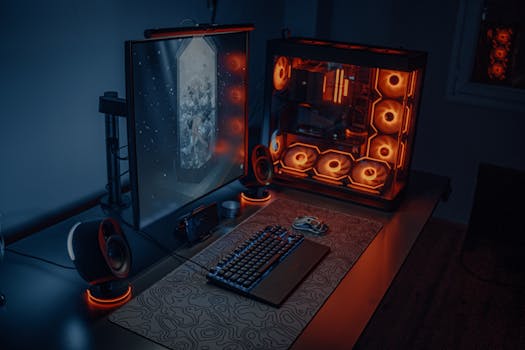 Photo: Atahan Demir / Pexels
Optimizing Your Ray Tracing Experience: Tips and Common Mistakes
 Photo: https://kaboompics.com/ / Pexels
Comparison
| Feature | Ray Tracing | Traditional Rasterization | Pre-baked Lighting |
|---|---|---|---|
| Reflection Accuracy | Physically accurate, dynamic | Screen-space or static cube maps | Static, non-dynamic |
| Shadow Realism | Dynamic, realistic softness/penumbra | Shadow maps, often jagged/less realistic | Static, no dynamic light interaction |
| Global Illumination | Real-time, physically accurate bounces | Approximated, often pre-calculated | Static, no indirect light bounces |
| Performance Impact | High, requires dedicated hardware | Lower, highly optimized | Very low (pre-rendered) |
| Hardware Requirement | High-end modern GPU with RT cores | Any modern GPU | N/A (rendering, not real-time) |
| Dynamic Lighting | Excellent, real-time response | Limited, relies on approximations | None (static) |
| Immersion Level | Superior, hyper-realistic | Good, but less lifelike | Moderate, can feel artificial |
What Readers Say
"Understanding what is ray tracing in gaming completely transformed my perspective on game graphics. The reflections in Cyberpunk 2077 are just breathtaking, making the city feel incredibly alive. It truly adds another layer of immersion I didn't know I was missing."
Alex P. · Seattle, WA"I was skeptical about ray tracing at first, but after playing Control with it enabled, I'm a believer. The way light bounces and shadows fall is so realistic, it makes the game's brutalist architecture even more stunning. It's a game-changer for visual fidelity."
Maria S. · Austin, TX"My new RTX card with ray tracing is amazing. The difference in games like Metro Exodus is night and day; the lighting and atmosphere are so much more intense. I actually achieved better frame rates than I expected thanks to DLSS, which is a huge bonus."
John D. · Miami, FL"Ray tracing is fantastic, but it definitely hits performance hard. I love the realistic reflections in Spider-Man Remastered, but I had to dial back some other settings to keep a smooth framerate. It's a trade-off, but usually worth it for the visual upgrade."
Emily R. · Denver, CO"For me, what is ray tracing in gaming boils down to pure immersion. In horror games, the dynamic shadows and realistic lighting make every jump scare and dimly lit corridor ten times more effective. It's not just prettier; it enhances the entire gameplay experience."
Chris B. · Chicago, ILFrequently Asked Questions
What is the main benefit of ray tracing in gaming?
The main benefit of ray tracing in gaming is its ability to produce incredibly realistic and physically accurate lighting, reflections, and shadows. This leads to a much more immersive and visually stunning game world, where light behaves just as it would in reality, enhancing depth and atmosphere.
Does ray tracing significantly impact game performance?
Yes, ray tracing is a computationally intensive technology that can significantly impact game performance, often leading to lower frame rates. This is why modern GPUs have dedicated hardware (RT Cores/Ray Accelerators) and why upscaling technologies like DLSS and FSR are crucial to maintaining playable frame rates while using ray tracing.
How do I enable ray tracing in my games?
To enable ray tracing, you first need a compatible GPU (NVIDIA RTX or AMD Radeon RX series) and a game that supports ray tracing. Once in the game's graphics settings, look for 'Ray Tracing' options, which usually allow you to enable specific effects like reflections, shadows, or global illumination. Ensure your GPU drivers are up to date.
Is ray tracing worth the performance hit?
Whether ray tracing is worth the performance hit depends on your personal preference and hardware. For many, the visual fidelity it adds to reflections, shadows, and global illumination is a game-changer for immersion. With modern upscaling technologies, the performance impact can often be mitigated, making it a worthwhile trade-off for a more realistic experience.
How does ray tracing differ from traditional rasterization?
Traditional rasterization projects 3D models onto a 2D screen and approximates lighting, while ray tracing simulates the path of individual light rays as they interact with objects in the scene. Ray tracing is physically accurate, leading to more realistic reflections, shadows, and global illumination, whereas rasterization uses various techniques to achieve similar, but less accurate, effects.
Who should use ray tracing in gaming?
Ray tracing is ideal for gamers who prioritize visual fidelity and immersion, own a modern high-end GPU with dedicated ray tracing hardware, and are looking for the most realistic lighting and reflections possible in their games. It's particularly impactful in games with dynamic environments and reflective surfaces.
Are there any downsides to using ray tracing besides performance?
Beyond performance, some minor downsides could include increased power consumption from your GPU and potentially higher temperatures. Also, if upscaling technologies are used aggressively, very subtle visual artifacts might occasionally be present, though these are often imperceptible during gameplay.
What is the future of ray tracing in gaming?
The future of ray tracing in gaming looks bright, with continuous hardware improvements making it more efficient and accessible. Expect to see more games incorporating ray tracing, expanded and more complex implementations, and further advancements in upscaling technologies, eventually making ray tracing a standard feature across all gaming experiences.
Now that you have a comprehensive understanding of what is ray tracing in gaming, it's time to experience this revolutionary technology for yourself. Upgrade your setup or simply enable it in your favorite compatible games to unlock a new level of visual realism and immersion. The future of gaming graphics is here, and it’s brilliantly illuminated by ray tracing.